
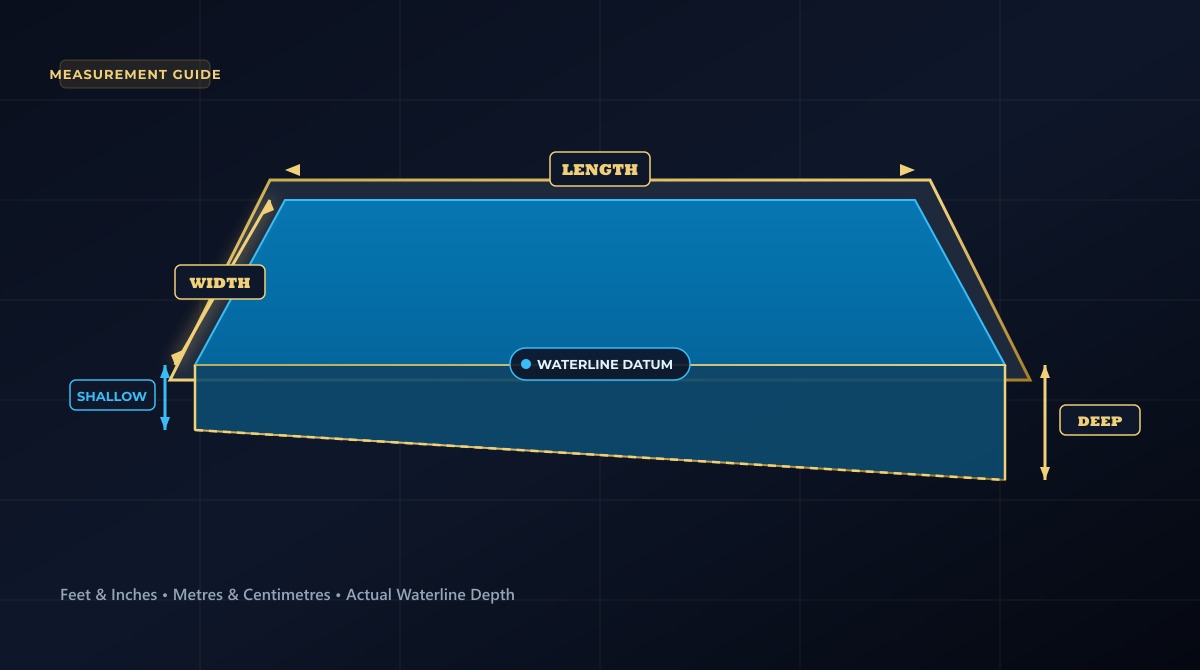
Measure a pool for volume by recording the inside water dimensions required by its shape and measuring actual water depth from the waterline to the pool floor. Convert feet and inches or centimetres into consistent decimal units before applying any volume formula. Taking measurements from the wrong starting point — such as the top of the coping stones or outer pool shell — produces an inaccurate water volume that distorts chemical dosing and pump sizing.
Once you have your measurements ready, enter them into the Pool Volume Calculator for an immediate capacity result.
Where Pool Measurements Should Start and End
Accurate pool volume calculations require dimensions that reflect the actual water envelope, not the exterior masonry or structural shell. Measure only the space that contains water.
Always measure depth from the operating waterline down to the floor. Wall height includes empty freeboard that contains no water.
Inside Water Dimensions
Measure length and width from the inside surface of one wall to the inside surface of the opposing wall. Do not hook the measuring tape over the coping stones, pool deck edging, or exterior support brackets. Including coping or deck cantilever adds 4 to 12 inches (10 to 30 cm) to each side, creating an exaggerated volume figure.
Waterline vs Wall Height
Water rarely reaches the absolute top rim of a pool basin. Most in-ground and above-ground pools operate with a freeboard gap of 4 to 8 inches (10 to 20 cm) between the water surface and the top of the wall or skimmer opening. Measuring total wall height instead of water depth overestimates water volume by 10% to 20% in typical residential pools.
The Pool Floor Datum
Record water depth down to the actual pool liner or plaster floor. In pools where silt, sand or debris has settled on the floor, ensure the measuring pole touches the firm interior surface.
How to Measure Pool Length and Width
Length and width measurements establish the pool surface area. The technique depends on whether the pool has straight, curved, or multi-directional walls.
Rectangular Pools
Measure the inside length along the long straight wall and inside width along the short wall. For pools with rounded corners (known as radius corners), keep the tape measure aligned with the straight section of the wall rather than measuring into the corner curve. Calculate the volume with the dedicated Rectangular Pool Volume Calculator.
Oval Pools
An oval pool requires two measurements: the major axis (maximum inside length) and the minor axis (maximum inside width). Pull the measuring tape through the center of the pool along its longest straight span, then measure across the widest point at a 90-degree angle. Check results on the Oval Pool Volume Calculator.
L-Shaped Pools
Divide an L-shaped pool into two distinct, non-overlapping rectangles: the main pool section and the smaller branch or toe section. Measure inside length and width separately for each section. When you calculate volume using the L-Shaped Pool Volume Calculator, you calculate each section and sum the volumes together.
How to Measure a Round Pool
Round pools require only one primary horizontal measurement: the diameter. The radius is then calculated by dividing the diameter by two.
Ensure the measuring tape crosses the exact center point to record the true maximum diameter.
- Position the start of your measuring tape on the inside waterline on one side.
- Extend the tape across the pool to the opposing wall, sweeping slightly until you find the maximum span reading. That longest span is your true diameter.
- If the pool measures 24 feet across the center, the diameter is 24 ft and the radius is 12 ft.
You can verify round pool capacity on the Round Pool Volume Calculator.
How to Measure Pool Depth
Pool depth refers strictly to water depth, not the distance from the top of the pool wall. Use a rigid telepole or weighted measuring line held vertical to the floor.
Constant-Depth Pools
Many flat-bottom above-ground pools and lap pools have a single uniform water depth across their entire area. Measure the water depth at two opposite points to confirm the floor is level. If both readings are 4 feet, use 4 ft as the depth input. For above-ground pools with specific wall ratings, review the Above Ground Pool Volume Calculator.
Shallow and Deep Ends
Most in-ground residential pools feature a shallow end that slopes down to a deep end. You need two distinct measurements:
- Shallow-End Depth: Measure from the waterline down to the floor in the flat shallow area.
- Deep-End Depth: Measure from the waterline down to the deepest point directly over the main drains.
When the floor transitions with a reasonably uniform, steady slope between both ends, calculate average depth with this formula:
Example: A pool with a 3 ft shallow end and an 8 ft deep end has an average depth of (3 + 8) ÷ 2 = 5.5 ft.
Hopper or Multi-Level Floors
Some pools feature a hopper bottom: a shallow ledge that drops abruptly into a deep diving bowl with steep sloped side walls. In this configuration, taking a simple midpoint average overstates water volume, because the steep side slopes displace significant water volume. Note where the transition break occurs if you plan to section the pool for calculation.
How to Measure in Feet and Inches
Measuring tapes in the United States and parts of North America display measurements in feet and inches (such as 15 ft 6 in). However, pool volume formulas require decimal feet (such as 15.5 ft). Entering inches directly as decimals — for example, entering 15.6 instead of 15.5 — causes calculation errors.
Convert inches to decimal feet by dividing the inch measurement by 12:
| Inches (in) | Fraction of a Foot | Decimal Feet (ft) |
|---|---|---|
| 1 in | 1/12 ft | 0.083 ft |
| 2 in | 1/6 ft | 0.167 ft |
| 3 in | 1/4 ft | 0.250 ft |
| 4 in | 1/3 ft | 0.333 ft |
| 6 in | 1/2 ft | 0.500 ft |
| 8 in | 2/3 ft | 0.667 ft |
| 9 in | 3/4 ft | 0.750 ft |
| 12 in | 1 ft | 1.000 ft |
Example: If your pool measures 16 feet 9 inches wide:
- Divide 9 inches by 12: 9 ÷ 12 = 0.75 ft.
- Add to 16 feet: 16 + 0.75 = 16.75 ft.
How to Measure in Metres and Centimetres
In metric countries, pool dimensions are commonly measured in metres and centimetres. Pool formulas require dimensions in decimal metres:
Example: A pool measured at 1 metre and 45 centimetres deep:
- Divide 45 cm by 100: 45 ÷ 100 = 0.45 m.
- Add to 1 metre: 1 + 0.45 = 1.45 m.
Carrying metric dimensions in metres allows direct calculation of cubic metres (m³), which convert cleanly to litres (1 m³ = 1,000 L), as explained in our guide to Pool Volume Units and Conversions.
What Measurements Does Each Pool Shape Need?
Before heading out with your measuring tape, verify the exact set of measurements required for your pool geometry:
| Pool Shape | Required Horizontal Dimensions | Depth Measurements Required |
|---|---|---|
| Rectangular | Inside length, inside width | Shallow depth, deep depth (or constant depth) |
| Round | Inside diameter at widest center span | Constant depth (or shallow/deep if sloped) |
| Oval | Long axis (length), short axis (width) | Shallow depth, deep depth |
| L-Shaped | Length & width of Main; length & width of Toe | Depth for each section |
| Kidney | Total length, width of lobe A, width of lobe B | Shallow depth, deep depth |
| Grecian | Main length, main width, corner cutoff dimensions | Shallow depth, deep depth |
For pools with distinctive irregular contours, such as kidney layouts, refer to the Kidney Pool Volume Calculator for specialized shape coefficients.
How to Measure an Irregular or Freeform Pool
Irregular and freeform pools feature curved perimeters that do not follow simple geometric formulas. To measure a freeform pool:
- Establish a Baseline: Measure the maximum overall length across the pool from inside wall to inside wall.
- Take Multiple Width Cross-Sections: Measure the width at three or four evenly spaced intervals along that length line (such as the wide shallow lobe, the narrow center waist, and the wide deep lobe).
- Average the Widths: Add the width measurements together and divide by the number of measurements to calculate a representative average width.
- Record Water Depths: Measure shallow-end and deep-end water depths at the center of each main section.
Sectioning the pool into modular geometric components provides an accurate representation without complex calculus.
Common Pool Measurement Mistakes
Frequently Asked Questions
Should I use wall height or actual water depth?
Do I measure from inside wall to inside wall?
How do I measure a round pool?
Can I use feet and inches together?
What if my pool has different depths?
Accurate pool volume calculations begin with sound measurements: measure inside wall-to-wall dimensions at the waterline, record depth down to the pool floor, and convert all fractional units into decimal feet or metres before calculating.
When your measurements are complete, apply them directly using our full Pool Volume Calculation Formulas guide or calculate capacity instantly with the Pool Volume Calculator.
Sources & Methodology
Measurement procedures and dimensional tolerances conform to guidelines published by the Association of Pool & Spa Professionals (ANSI/APSP-1) and unit conversion standards established by the National Institute of Standards and Technology (NIST SP 811). For detailed geometric modeling limits, see our Calculation Methodology.